
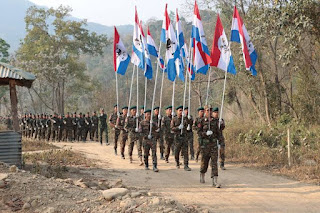
June 23, 2025: The Chin National Front/Army (CNF/CNA) has called on all revolutionary forces in Chin State to resolve territorial disputes peacefully and focus on the shared goal of overthrowing the Military Council. "Our goal is to overthrow the Military Council, not to fight over land. During this period, groups should move freely in and out of each other's areas without encroachment or clashes," CNF/CNA spokesperson Salai Htet Ni told Mizzima on 19 June.
His remarks came in response to a joint statement issued the same day by 18 Chin organizations, urging armed groups to preserve unity and rebuild Chin State together after the revolution. The statement warned that frequent clashes between Chin resistance groups, and efforts to settle disputes through violence, could delay or even derail the success of the revolution.
The signatory groups urged Chin revolutionary organizations to avoid misunderstandings, reject misconduct, and focus on the common enemy. They emphasized that territorial and ethnic issues in Chin State should be addressed politically after the fall of the junta.
Tensions have already escalated in several areas. In Falam Township, a dispute between the Chin National Organization/Chin National Defense Force (CNO/CNDF) and the CDF–Hualngoram faction has created military strain. Clashes have also erupted between the Chin National Army (CNA) and the Chin Defense Force – Kanpetlet (CDF–Kanpetlet) in Kanpetlet Township.
Salai Htet Ni acknowledged that township-based, local, and administrative groups formed during the Spring Revolution have played important roles but also contributed to disputes over authority and territorial recognition.
Across Chin State, groups such as the Zanniatram CDF and CDF–Hualngoram have been formed to protect ancestral lands. In Thantlang Township, groups like the Chin Defense Group – Thantlang and the Sethang Army operate alongside others. Hakha Township is home to the CDF–Hakha and local defense groups including Mara, Lauk Tu, and Zofei. Without any functioning constitution such as the suspended 2008 charter, Chin State has reverted to a pre-independence state. The original nine-township system has proven inadequate, with some ethnic groups divided across multiple jurisdictions. Many now seek reunification and a new administrative structure that better represents their identities.
Chin revolutionary leaders point out that in Falam Township alone, twelve different ethnic groups reside, making past township borders impractical for modern governance. Despite differences, the CNA spokesperson noted that both the Chin Brotherhood (CB) and Chinland Council (CC) remain committed to the same objective. He said the groups differ only in strategy and continue to work together in the fight against the Military Council. He emphasized that any territorial disputes must be resolved through political dialogue, mutual trust, and a roundtable approach – not through conflict.
Salai Htet Ni also stressed the importance of striking a balance between military strength and political legitimacy, reminding all groups to stay rooted in the people's needs and aspirations. To help mediate tensions, a negotiation team led by the Chief Minister of Mizoram, India, has been facilitating dialogue between the Chin Brotherhood and the Chinland Council. While initial agreements have been reached and on-ground tensions eased, discussions are still ongoing.
The joint statement from the 18 groups affirmed that the Military Council, having seized power from the people, must be dismantled. It pledged support for all Chin forces working to establish a genuine federal democratic union, protect the Chin homeland, and achieve full self-determination. Mizzima has not yet received a response from the Chin Brotherhood regarding the joint statement.
Among the 18 signatories such as Zotung Federal Council, CDF Zotung, CDF – Matupi, CDF – Kalay, CDF – Hakha Central Council, CDF – Thangtlang, Lautu Region People Administration (CDF – Lautu), Zopheiram Council (CDF – Zophei), Maraland Council (CDF – Mara), Paletwa Council (CDF – Paletwa), Mindat Council, Senthang Central Council – SRF, Tedim Township Council (PDA), Tonzang Township Council (CDF – Tonzang), Siyin Regional Council (CDF – Siyin), Kanpetlet Council, CDF – Zanniatram, and CDF – Hualngoram. All are current members of the Chinland Council.
ZOFA JOURNAL
His remarks came in response to a joint statement issued the same day by 18 Chin organizations, urging armed groups to preserve unity and rebuild Chin State together after the revolution. The statement warned that frequent clashes between Chin resistance groups, and efforts to settle disputes through violence, could delay or even derail the success of the revolution.
The signatory groups urged Chin revolutionary organizations to avoid misunderstandings, reject misconduct, and focus on the common enemy. They emphasized that territorial and ethnic issues in Chin State should be addressed politically after the fall of the junta.
Tensions have already escalated in several areas. In Falam Township, a dispute between the Chin National Organization/Chin National Defense Force (CNO/CNDF) and the CDF–Hualngoram faction has created military strain. Clashes have also erupted between the Chin National Army (CNA) and the Chin Defense Force – Kanpetlet (CDF–Kanpetlet) in Kanpetlet Township.
Salai Htet Ni acknowledged that township-based, local, and administrative groups formed during the Spring Revolution have played important roles but also contributed to disputes over authority and territorial recognition.
Across Chin State, groups such as the Zanniatram CDF and CDF–Hualngoram have been formed to protect ancestral lands. In Thantlang Township, groups like the Chin Defense Group – Thantlang and the Sethang Army operate alongside others. Hakha Township is home to the CDF–Hakha and local defense groups including Mara, Lauk Tu, and Zofei. Without any functioning constitution such as the suspended 2008 charter, Chin State has reverted to a pre-independence state. The original nine-township system has proven inadequate, with some ethnic groups divided across multiple jurisdictions. Many now seek reunification and a new administrative structure that better represents their identities.
Chin revolutionary leaders point out that in Falam Township alone, twelve different ethnic groups reside, making past township borders impractical for modern governance. Despite differences, the CNA spokesperson noted that both the Chin Brotherhood (CB) and Chinland Council (CC) remain committed to the same objective. He said the groups differ only in strategy and continue to work together in the fight against the Military Council. He emphasized that any territorial disputes must be resolved through political dialogue, mutual trust, and a roundtable approach – not through conflict.
Salai Htet Ni also stressed the importance of striking a balance between military strength and political legitimacy, reminding all groups to stay rooted in the people's needs and aspirations. To help mediate tensions, a negotiation team led by the Chief Minister of Mizoram, India, has been facilitating dialogue between the Chin Brotherhood and the Chinland Council. While initial agreements have been reached and on-ground tensions eased, discussions are still ongoing.
The joint statement from the 18 groups affirmed that the Military Council, having seized power from the people, must be dismantled. It pledged support for all Chin forces working to establish a genuine federal democratic union, protect the Chin homeland, and achieve full self-determination. Mizzima has not yet received a response from the Chin Brotherhood regarding the joint statement.
Among the 18 signatories such as Zotung Federal Council, CDF Zotung, CDF – Matupi, CDF – Kalay, CDF – Hakha Central Council, CDF – Thangtlang, Lautu Region People Administration (CDF – Lautu), Zopheiram Council (CDF – Zophei), Maraland Council (CDF – Mara), Paletwa Council (CDF – Paletwa), Mindat Council, Senthang Central Council – SRF, Tedim Township Council (PDA), Tonzang Township Council (CDF – Tonzang), Siyin Regional Council (CDF – Siyin), Kanpetlet Council, CDF – Zanniatram, and CDF – Hualngoram. All are current members of the Chinland Council.
ZOFA JOURNAL
.jpeg)


No comments:
Post a Comment
Comments not related to the topic will be removed immediately.