Tuesday, January 15, 2013

History of Thangkhal: Seminar paper presented...


History of the Thangkhals
~ Lianzalal, MA( Pub. Admn.)

[Seminar paper presented during National Seminar on Zou Language and History conducted by Zou Literature Society (ZLS), Manipur on January 3-5, 2013 at Zogal Hall Complex, Churachandpur, Manipur, India.]
There is almost no account of the Thangkhals, however, we cannot simply deny their existence. This is evident from our oral history. Our history, customs and culture evolved from the oral accounts, tales, folklores, folk songs, etc. Narrating or story telling was common among the Thangkhals in the olden days. The Thangkhal peoples want to preserve their dialect which became their identity in the present.

ORIGIN
The Thangkhals belong to ‘Chin-Kuki-Mizo-Zomi’ family of Tibeto-Burman race. This stock originated from the Mongolian race. The Thangkhal, themselves were known as ‘Zou’ in the olden days. They believed to be the descendants of the progenitor ‘Zo’ or ‘Jo’ or ‘ Yao ’. The early descendants of ZO progenitors were believed to be ‘Songthu’, ‘Songza’ and ‘Zahong’. 

Terminology
The word ‘Thangkhal’ derived from the two syllables -‘Thaang’ which means ‘a hilly region’, while ‘Khalh’ means ‘a dense form of fog’. Similarly, the other possible root word of ‘Thangkhal’ is believed to be ‘Thaang Kaai’, which signify a mountainous region, where no one landed before. 

Traditional shawls
The traditional tribal clothes like ‘Puanlaisan’, a shawl made of red-woven fabricated thread; and ‘Puandum’, a textured of white, green and red coloured shawl, were their traditional shawls. The Thangkhals called ‘Gungal Puan’. 


Festivals
The Thangkhal peoples were fond of celebrating festivals throughout the year. Some of their festivals are:- Gaal Aih (Head Hunting Festivals), Sa Aih (Wild Beast), Miim Kut (Maize), Taang Kut (Barley), Khuadou Pawi (Harvesting Festivals) and Ton (A festival of a prosperous and famous person). All the festivals were celebrated in prompt and gaiety. During festivals, the most common part is dancing ‘Laamkaih’ and singing ballads ‘Sannemla’ together by holding each other. On this occasions, local made wine ‘Zupi’ is usually served to everyone. 

Village administrations
Every Thangkhal village has a Chief (hausa) assisted by few selected village elders in looking after the administration of a village. Decision taken by them was final and binding. The Chief is the most powerful administrators in the village. Beside, some important persons of the village includes namely, Tualupa (Senior elders), Siampu (Priest); Taangsampa (Messenger); Sa-aineite or Sazawlneite (Good hunters/ Sharp shooters); Galhangte (Brave Warriors) and Sikkhengpa (Blacksmith).
 
Family life
The father is the head of the family and the eldest son usually took charge when the father dies. However, there are certain appointed close relatives to stand by the family through thick and thin, and these persons are collectively called the ‘Innsung Dongta’. They are - (i) Bangkua, (ii) Bangkuazom, (iii) Thusa, (iv) Zawl,(v) Nuphal, (vi) Sasem. Besides, there are - (i) Tanutaak, (ii) Tanuzawm, (iii) Tanu Thumna, (iv) Tanu Lina, (vi) Tanu Ngana. 

Taitam - the first home of Thangkhals
Literally, the word ‘Taitam’ has two similar meanings i.e., ‘Long staying escaped people’ or ‘Numerous survivours’. It is the first village built by the Thangkhals somewhere in China-Burma border, after leaving the dreaded Khul cave. The village was said to be built before the Thangkhals built their own village in Burma or elsewhere. 

Thangkhal dialect
The Thangkhal have a peculiar type of dialect called ‘Thangkhal Haam’ from time immemorial. Thangkhal dialect is closely related to Paite, Tedim and Zou tribe. These dialects were indeed, similar, but a varied differentiation in tones, accents and meanings, too. The Thangkhals practised a common dialect, culture, custom and tradition from the time immemorial. Some typical words of Thangkhal dialect were- Vevaw, Tazen aw, Niaknuak, Valong and Mataw. Thangkhal dialect has its uniqueness which could identify themselves from their neighbouring tribes. 

Thangkhal khawpi – the first village of Thangkhals in Chin hills
The exact date of Thangkhal khawpi establishment is not available. However, it is believed that Thangkhal khawpi is older than the famous ‘Tedim’. Thangkhal khawpi was established by the Thangkhals. 

The reign of the Sukte Chiefs
In the 16th century, the Pawis and the Suktes emerged as the powerful tribal kings in the entire Chin Hills . This two royal chiefs frequently clashes over the supremacy of the Chin Hills . The feudal conflicts lasted for many decades. During those periods, the Pawis were considered as the fierce warriors who dominated the land. 

Since the rise of Pawi kings, every tribal villager feared them. So they gave land tax known as ‘Khasana’. The Pawis were more advanced than the Suktes. In those days, Pu Khanthuam Sukte lived in Mualbem villge. He is the only one among the Zomi, who could communicate friendly towards the arrogant Pawis. His diplomatic nature earned him great honour. Thus, the Zomis living in Tedim village requested him to send one of his sons to be the Chief. So that, the Pawis might hesitate to attack Tedim in future. Since the Zomis trusted Pu Khanthuam, he send his eldest son Kamhau as a Chief of Tedim Village. Kamhau have eight sons. They are: Zatual, Lianthang, Sawm hau, Paumang, Thuamkhawlian, Thangkhawpau, Haupum and Khawcin. Pu Khawcin did not have son, so his brother Haupum inherited the property. 

Accordig to Sukte Custom, the youngest son inherited the property of his father. When the sons of Khanthuam got married, they were sent-off into different villages to hold the Chiefship. In due course of time, this led to the expansion of the Sukte kings in the Chin Hills. 

During the reign of Kamhau, the Tedim villagers collected several weapons like Zothau (tribal made gun), Thalpi-Thaltang (bows & arrows), Teipi (Spears), Namsau (Swords), Namta (Knifes), Sou –Thaang (Sharp pined Traps/nets), etc. as much as possible to protect from any kind of invaders. From that time onward, the brave Pawis could not attack Tedim village. Gradually, the Zomis began paying taxes to Kamhau and the Sukte Chiefs. This marked the end of paying tax to the Pawis. Within a short span of time, Pu Kamhau became the great ruler in Chin Hills. 


A description of Thangkhal Khawpi
Meanwhile, the Thangkhal Khawpi is well-established and the Thangkhals were well-settled in their own home. Pu Thuamkhawlian, the fifth son of Sukte king ‘Kamhau’, had an envious heart to rule the Thangkhal Khawpi when he knew the Thangkhals were free. As agreed by the Sukte family, Pu Thuamkhawlian along with some Sukte families and servants came and settled down in Thangkhal Khawpi. Soon, he took the ownership of Village Chief in Thangkhal Khuapi. By that time, the majority of Zomi villages were under the rule of the Sukte kings. 

The Thangkhal Khawpi has two local areas, viz, Boutung Veng (Upper part) and Bounuai Veng (Lower lowlands). The Chief and his Sukte brethrens concentrated in Boutung Veng, and the Thangkhals (the village builders) lives in Bounuai Veng. The Suktes and the Thangkhals lived peacefully together for many decades. The Village Chief, Pu Thuamkhawlian was highly honoured by the Thangkhals and he, too, loved the Thangkhals affectionately. The relationship between Sukte and Thangkhals became a strong bond of co-existence. It was around 16th-17th century AD, according to our forefathers. 

The fall of Thangkhal khawpi
One day, it so happened that the childrens of Boutung and Bounuai of Thangkhal Khawpi quarrelled fiercely by shooting one another with Saili (catapult) and Thoupong (bamboo-made sling). The quarrel took an ugly turn and even the adults were at logger-heads. In the turn of events, the Chief Thuamkhawlian having noticed the attitude of the Thangkhals, approached them in good-will by following the usual practice of the old customs and cultures. He, thereby, offered Zu Beelpi khat (a big pot of local rice-beer) as ‘Zu Um Tun’ for appeasement of the Thangkhals. He also killed a pig and made a Lemna Annkuang (Peace-Dinner) with the sobbed Thangkhals at Pu Thahvum's residence. Even though, the Chief adopted different ways to persuaded the angry Thangkhals not to leave the village. The Thangkhals, on the other hand, were adamant to it and vowed to leave the place once and forever secretly. 

One day, there was a festival in the village. In the dead of the night, the Thangkhals destroyed all their ovens to mark the end of living in their house. The Thangkhals secretly left their sweet home in tears, before the dawn break. Two young girls were left forgotten while they served the festive villagers on that fateful night.

On the following morning, Pu Thuamkhawlian, the chief came to knew all the doors of the Bounuai were closed. Besides, a silent atmosphere prevails in the Bounuai areas. This alarmed the Suktes of the Boutung. So much so that, the Suktes intended to kill all the Thangkhals who left home. In this traumatic situation, the Village Chief consoled the hearts of the furious Suktes. 

Pu Thuamkhawlian, calmed down his fellow men with a word, "My dearest villagers, please calm down the idea of persuading our Thangkhal brethrens. If you do so, you might not return home safe and sound. May it be known to all of us that Pu Thahvum, Pu Phungsel, Pu Lingtut were great warriors who had never missed their target even once in their attempt. They were brave and courageous. From their threshold, they even had the courage to shoot down an egg placed upon the heads of their wives. Not only that, they had with them ten brave warriors whose skilled was second to none in shooting of guns. We were not worthy to be mentioned to match their skill. Rather, we should negotiate them by peaceful means only." By then, the Chief un-expectedly succeeded in persuading his villagers who tried to pursue the Thangkhals by any means.

The journey of the Thangkhals
Just after leaving the Thangkhal Khawpi, warriors of sharp shooters led the crowded people and a number of strong men guarded them throughout the journey. After moving from the Thangkhal Khawpi, they came and crossed the Meitei Guun (Imphal river) which is situated below the village of Tuithang beyond the river. Even to this border, Pu Thuamkhawlian and his men chased them, and met them. He strongly persuaded the Thangkhals to return back home and settle peacefully in the same village. But the Thangkhal peoples turned down his request by saying that they would not settled in a place where they had already destroyed their ovens. Pu Thuamkhawlian returned home dejectedly.

Ancrestral journey
After the ancestors had left the Thangkhal’s village, they had travelled through these places, viz, Thangkhal, Tuithang, Ngialzang, Suangsang, Philnak, Tal-ek, Nivangtaang, Singgial, Khawdam, Aisih, Siallutaak, Hiangtam, Paldai, Thangkhallamtun, Tuita, Tanmun, Thonghau Thangpikot, Tuaiteng Vum, Gallamtaang, and Mulaam.

The Mulaam village
Mulaam Village came to be the first village of the Thangkhals in Manipur Southern Hills. While arriving at the mountain, the elders of Thangkhals discussed to set-up their own village so that they could live together again. By that time, they saw a soaring kite casting a lot upon which animal or insect could be its prey. Taking as a clue from the kite, the Thangkhals believed that the hill where the shadow of an eagle fell would be a suitable place to live in. Thus, the Thangkhals set-up a hilly village called ‘Mulaam’, which means ‘A soaring kite’. It was around the 1800-1850 A.D that the Thangkhals came to settle in Manipur.
Mulaam is situated on the top of a mountain lying between the left hill ‘Khulh Vum’ and right hill ‘Gamdawng Vum’. The geographical location of Mulaam contributes significant advantages to the villagers in many ways. The village was entirely surrounded by mud walls, which has two holes – Entry (in) and Exit (out), in order to protect from any attacks. At Kulh Vum hill, a sentry (duty) post was built and a wooden gong was hung throughout the day. From Kulh Vum, the surrounding village is completely visible. This hill was the duty place of the Thangkhals in the early days.

Separation from Mulaam village
Pu Thahvum and Pu Phungsel had advised and gave the caretaker of Mulaam village into the hands of their nephew Pu Mangminthang. After that, they separated each other and established different village in search of fertile land. Pu Phungsel established Tuallian village and Thahvum established Sialkawng village. Pu Thahvum also established another village Suangkuang. And some of them who neither live at Tuallian nor Sialkawng settled at Kamkeilon. Thus, the Thangkhals scattered and established their own village as they wish. A number of Thangkhal villages existed within a short span of time.
 
The following are the villages established by the forefathers of Thangkhal
Old Khaukual (1846), Tuidam (1910), T. Khajang (1915), Gangpimual (1915), T. Khuangkhai (1920), Khuainuai (1930), Hiangtam Khonou (1938), Suangkuang (1940), Kullian (1940), Tuibuang (1946), Ngoiphai (1946), M. Tanglian (1947), Saiboh (1950), M. Khuangmun (1951), M. Khaukual (1955), S. Belbing (1960), Teikot (1969), Phaisan (1970), M. Buangmun (1971), S. Geltui (1971), S. Munhoih (1973), Teisalzang (1975), M.T. Geltam (1975), T. Kotlian (1975), V. Suangzang (1980), Zoukhuonuam (1996), Goshem (1998), S. Phaiza (2006), M. Salzang (2006), Singheu, Kullian, Daktum, Muallum, S. Zezaw, Kamkeilon, etc.

Christianity
There came an old man. Pu Thawngluan, an evangelist of the erstwhile Convention Church (Now EBCC) came to Mulaam to preach the Gospel. The Mulaam Thangkhals vehemently opposed him so he could not enter Mulaam. Pu Thawngluan had toured and visited all the Thangkhal’s village to preach his Gospels. The Thangkhals, on the other hand, tortured him mercilessly wherever they met. This man of God was shot with slings and even stoned at him. He was also splashed with swine’s food.

During those days, the Thangkhals hates Pu Thawngluan as a sign of ‘Bad Omen’ or ‘A Curse of Evil’. Since his arrival, the children were thought to be unhealthy, which fuelled headache to many parents. All the blames fell on this old man. The Thangkhals did not welcome him in their village.

Then Pu Thawngluan approached another Thangkhal’s hamlet called ‘Khajang’ on 7th March, 1939. In this village, he was permitted to stay in the village by the chief Pu Ulchin. From Khajang, Thawngluan began preaching the Gospel among the Thangkhals. Pu Ulchin received Baptism from Pu Thawngluan. He was the first baptized Thangkhal. Gradually, the Gospel touched every nook and corner of Thangkhal’s land. 

In the 1940’s, the Thangkhals became Christians. The Christians were that time classified as ‘Tapidaw’ which means ‘Believers of Christ’. In those days, the early Christians suffered the brunt of Lawki followers. The old-aged Lawki religion has gradually disappeared from the Thangkhal villages. Pu Thawngluan worked and lived among the Thangkhals till 1947. Unfortunately, he breathed his last on July 2, 1983.

[ The life and struggle of Pu Thawngluan among the Thangkhals was realistically portrait in ‘Taanglai leh Tu-hun’, the first Thangkhal film ever made in the early 90s.]


Church
The Thangkhal Christians were scattered in different churches such as – Kuki Christian Association, Convention Church and Presbyterian Church. It was only after 42 years of Christianity, the idea of unification through church developed in the minds of the scattered Thangkhals. Thus the Thangkhals established ‘Thangkhal Christian Association (T.C.A)’on April 4, 1981 at M. Tanglian village. The first Thangkhal Christian song book, Pasian It La’ came out in 1982. After that a series of Songbook and Sunday School book/syllabus came out. A New Testament in Thangkhal dialect was translated and released in 2010.

Social Organisations
The Thangkhal Peoples’ Organisation (TPO) and Thangkhal Youth Organisation (TYO) came into being in 1978, Thangkhal Sinlai Pawlpi (TSP) in 1987 and Zomi Fins band in 1985.
 
* Italics by web administrator.
Bibliography:
[1] TSP SINLAI SUANGPHUM (Souvenir: 1987-2008)
[2] TBC Silver Jubilee Souvenir (1981-2006)
[3] TPO History & Custom Book (Undated)
[4] Khalvontawi.com (Thangkhal-based online portal)
[5] Thangkhal Yahoogroups (Discussion Forum)
[6] The Forgotten Tribe: Thangkhal (The Sangai Express, 17-09-2006]

Note: This seminar paper is prohibited to publish or webcast in print or online without the prior permission of the administrator.


Sunday, January 13, 2013

7 MEN ALLEGEDLY GANGRAPED A PUNJABI GIRL, 5 HELD

Gurdaspur (PUNJAB), 12 Jan 2013 [PTI]: In a case similar to the gang-rape of a physiotherapy student in New Delhi, a 29-year-old woman was allegedly gang-raped by seven persons in Gurdaspur in Punjab.

The victim was on her way to her village in Ghukla - which falls under Kahnuwan police station - in a bus when the driver and conductor kidnapped her and took her to an undisclosed location where they and their five accomplices gang-raped her last night, Gurdaspur Raj Jeet Singh, Senior Superintendent of Police (SSP), told reporters.

He said five of the seven accused had been arrested while two others, who are yet to be identified, were still absconding. Based on the interrogation of the five accused, efforts were on to arrest the remaining persons, he added.

The victim, in her complaint, said that she was coming back from her parent's village in Jagatpur in Pathankot in a bus but the driver, Daler Singh, did not stop the vehicle at the bus stand in Ghukla.

Her request to the conductor, Ravi, to ask the driver to stop the bus went unnoticed.

They took her to a place near Gurdaspur, where five of the duo's friends joined them and gang-raped the woman in a house, the police official said.

The driver dumped the victim at a place near her village this morning, he said. The woman first went to her house and then came to the police station to file her complaint, he added.

A case of rape under section 376 of the Indian Penal Code was registered against the seven accused, Mr Singh said.

The five arrested have been identified as Daler Singh, Ravi, Jaswinder Singh, Jagpreet Singh and Satwant Singh, he said.

Teams have been have been formed to nab the absconding men, he said.

Police said the First Information Report (FIR) was registered this evening.

The woman would be sent for medical examination, the police said, adding the accused had confessed to their crime during preliminary interrogation.

Friday, January 11, 2013

115 DIES IN PAKISTAN BOMB BLASTS

ISLAMABAD, 11 Jan 2013 [PTI/ Pic: AP] --- As many as 115 lives were lost in one of Pakistan's bloodiest days in recent times with a series of explosions rattling two cities of the restive provinces of Balochistan and Khyber-Pakhtunkhwa, one of them a major sectarian attack by a banned outfit.

Several security personnel and media persons were also killed on a bloody day which served as a grim reminder of the serious challenges being faced by the country from militants, religious extremists and separatists ahead of the upcoming general election.

In a series of attacks, terrorists targeted a security forces vehicle and a Shia-majority neighbourhood in Quetta, the capital of Balochistan, and a religious congregation in the Swat Valley of Khyber-Pakhtunkhwa, an erstwhile stronghold of the Taliban.

Balochistan's capital city Quetta was rattled by three bomb blasts that claimed at least 93 lives.

The worst of these attacks was at a snooker club where a suicide bomber blew himself up. The snooker club on Alamdar Road has two Shia prayer halls and a sizeable population of Shia Hazaras.

As media teams and security forces gathered in the area, another bomb went off, media reports said.

Cameraman Imran Sheikh and reporter Saif-ur-Rehman of Samaa TV channel, two police officers and several rescue workers were among the dead.

Several reporters, cameramen and technicians of news channels were injured.

Police said 81 people were killed in the two blasts and 120 injured, including 10 Army and police personnel.

Quetta's city police chief, Mir Zubair while confirming the death toll at 81 in the snooker club attack, said the casualties could rise as the condition of around 50 of the injured persons was critical.

"The second blast came minutes after the first one and the death toll is at 81 with around 130 injured in these blasts," he said.

Nine policemen including a DSP and SHO were also killed in the second blast as law enforcement agencies, rescue officials and media persons reached the scene.

DIG investigation, Hamid Shakeel said that as a result of the two blasts the four—storey building which housed the snooker club had collapsed. He said four rescue workers of Edhi Trust had also died in the blasts.

Earlier in the day, a bomb placed under a car near Bacha Khan chowk, apparently targeting a security checkpost went off, killing 12 people including two security personal and a child and left around 30 injured. An estimated 20 kgs of explosives were used in the attack.

Police said the blast was caused by a timed explosive device planted under the security forces vehicle. The blast caused a large crater and destroyed about 10 cars.

While the United Baloch Army claimed responsibility for the first blast, banned Lashkar—e—Jhangvi claimed the second attack.

Hours later, 22 people were killed and nearly 70 injured in an explosion at a "tablighi markaz" (preaching centre) near Mingora, the main town in Swat Valley, last evening.

The blast occurred in the basement of the centre at Takhta Band Road.

Initial reports said the blast was caused by a gas cylinder but police subsequently confirmed the incident was an act of terrorism.

Some reports said the attack was carried out by a teenage suicide bomber though this could not be independently confirmed.

Officials at a hospital in Saidu Sharif town said the dead and injured were hit by ball bearings, which are often used in explosive devices.

They confirmed 22 deaths and said several of the injured were in a serious condition.

The Swat Valley was a stronghold of the local Taliban till the army conducted an operation to flush out militants in early 2009. Most of the top Taliban commanders of the region escaped to Afghanistan.

Pakistan is scheduled to go to the polls sometime in April or May.

INDO-PAK BORDER BOILS TENSION

Jammu, 11 Jan 2013 [PTI] --- Tension on Friday prevailed along the Indo-Pak border in Jammu and Kashmir where Army was on alert after repeated ceasefire violations by Pakistani troops.

"The borderline with Pakistan is tense. But the situation is under control (along Line of Control in Jammu and Kashmir)", an Army official said on Friday.

The level of tension has increased after Pakistani troops violated ceasefire continuously and also closed the gates for cross-LoC trade on Thursday.

The Army is maintaining utmost vigilance along the borderline with Pakistan, he said, adding troops have been asked to remain alert round-the-clock.

"There was no ceasefire violation along Indo-Pak border this morning," Defence spokesman Col R.K. Palta said.

However, Pakistan troops had violated ceasefire and fired mortars shells and small arms on Indian posts along LoC in Krishnagati sector of Poonch district from 5 pm to 9.30 pm yesterday, the spokesman said.

Indian troops guarding the borderline effectively retaliated resulting in exchanges, he said, adding that there was no casualty or injury to any one in the firing on the Indian side.

Pakistani troops had fired at nine posts — Chatri, Atma, Helmet, Prakash, Chatyal, Khera-I, Khera-II, Roshni and Gunhill posts in the sector from its posts Kanal, Barmoch, Jungle-1, Jungle-2, Dhamas, Prench, New post, Daruchiymia, Teer, LP-1, LP-2 and LP-3.

Thursday, January 10, 2013

KUKI HERO WHO FOUGHT THE BRITISH IN 1917-19

Imphal, 09 Jan 2013 [SANGAI EXPRESS] --- The Kukis today remembered their hero Khotinthang Sitlhou who led the Thadou chiefs and declared war against the mighty British to defend and preserve Manipur's sovereignty popularly known as the Kuki Rebellion.

In commemoration of his leadership and sacrifice for the cause of the land, a memorial celebration was held at Taloulong village in Senapati district amid presence of ministers including Deputy CM Gaikhangam, legislators and Kuki leaders.

Khotinthang Sitlhou alias Kilkhoung Sitlhou, on behalf of all the Thadou (Kuki) chiefs, declared war on the British imperialists on March 17, 1917 for the preservation of freedom and independence of Manipur.

He was arrested along with the other leading Thadou chiefs and imprisoned at Sadiya in Assam and at the cellular jail in Andaman and Nicober Island.

Organized by Kilkhoung Memorial Celebration Committee, a monument as well as his statue was unveiled.

The Thadou war ( Kuki rebellion) lasted for three years from 1917 to 1919 during which 4900 people including civilians were killed and 10300 villages razed to ashes, said Thadou elders.

They said the war was declared closed on May 20, 1919 by Lt Gen HDU Henry Keary.

Though the war lasted for only three years, it produced far reaching consequences in the history of Manipur and the most significance outcome of it was the overall administrative reform in the hill areas, they said.

Expounding, they said that then Chief Commissioner of Assam Nicolas Dodd Beatson Bell had in October 1919 declared the decision of the Indian government to introduce the scheme promulgated for better administration in the hill areas of Manipur.

Under it, the hill areas were divided into three subdivisions and the administration of the land was put under the charge of European sub-divisional officer who were directly accountable to the president of the Durbar.

The dignitaries, who attended Tuesday's historic memorial celebration categorically praised Sitlhou's heroic leadership he took for the cause of the state.

Besides offering floral tributes of the hero's statue, the gathering also witnessed a spectrum of Kuki cultural dance.

TOI Social Impact Awards: Lifetime contribution


After an intense discussion, the jury decided the Naga Mothers Association and the Meira Paibis of Manipur should share the Lifetime Contribution Award. The fact that both groups are driven by women and have battled serious social and law-and-order problems in the northeast struck a deep chord with jury members. NMA and Meira Paibi have campaigned against alcohol and drug addiction, gender violance and human rights violations in their states. With their "Shed No More Blood" movement, the NMA has nurturned and sustained a ceasefire between Naga underground groups and the government, and continues to monitor the peace process. Historicially, the Naga and Meiti men have been in conflict, and initially, we were not sure if the women would accept a joint award. After several phone calls and meetings with senior TOI editors in Kohima and Imphal, and internal discussions of their own, both groups said they would be "honoured" to accept the award. (TOI photos by Anindya Chattopadhyay)]
Source: TOI. 

Wednesday, January 9, 2013

Qwaisi arrested for wagging war against state

Hyderabad, 09 Jan 2013 [PTI | Pic: TOI] --- After being on the run for long, Majlis-e-Ittehadul Muslimeen (MIM) legislator Akbaruddin Owaisi, was finally arrested on Jan 8 for a making slew of hate speeches aimed at tearing the nation's secular fabric.

The MIM legislator was taken into custody after subjecting him to a series of medical tests at the government-run Gandhi Hospital through the day to ascertain if he was fit to face questioning.

Owaisi, who returned from London early Monday, faces charges of waging or attempting to wage war against the state, promoting enmity between different groups on grounds of religion, and for deliberate and malicious acts intended to outrage religious feelings.

The 42-year-old heads the MIM in the Andhra Pradesh assembly. Representing Chandrayangutta constituency in the Old City of Hyderabad for a third time, he is the younger brother of MIM chief and MP Asaduddin Owaisi.

Owaisi, who underwent medical tests on a police directive to ascertain if he was fit to face questioning for his hate speech has hernia, adhesions in the abdomen and a bullet in his right thigh, according to the medical report.

The legislator underwent 11 tests at the government-run Gandhi Hospital here since 10.30 am with police waiting for the doctors' report before deciding to arrest him.

Akbar's lawyer came out of the hospital around 4 pm to announce that his client was being made to wait without breakfast.

Tension prevailed outside the hospital with hundreds of MIM workers reaching there to show solidarity with their leader. 

Some pelted stones on buses and other vehicles, forcing police to use force to disperse them. Police have sealed off all routes leading to the hospital.

Police also stepped up security in the communally sensitive old city in anticipation of protests by MIM in the event of Akbar's arrest. Paramilitary forces were also deployed in the old city and other parts of the city.

The situation remained tense in Nirmal town of Adilabad district where Akbar is likely to be taken after his possible arrest and in Nizamabad town where he was supposed to appear before police in a similar case.

Earlier, the legislator left his house in Banjara Hills for the hospital at 10.30 a.m. with tight police security after police officials served a notice asking him to undergo the medical tests.

A police official said at the time they would decide their next legal action after the tests.

MIM leaders including party chief and MP Asaduddin Owaisi were at Akbar's house before he left for the hospital.

Akbar, who returned from London early Monday, sought four days' time to appear before police citing ill-health.

He was directed by police to appear at the Nirmal town police station, about 200 km from here, for questioning with regard to his alleged hate speech delivered last month.

The investigating officer Monday night visited Akbar's house.

Inspector General of Police A.B. Venkateshwar Rao told reporters that the officer found Akbar in a fit condition but the legislator complained of some "internal pains".

The 42-year-old was seriously injured in an assassination attempt by his rivals in the old city in May 2011.

Police in Nizamabad had also directed Akbar to appear before them Tuesday in connection with a similar case in that town.

The young leader sought more time to make a personal appearance.

Akbar, who is a MIM member in the Andhra Pradesh assembly, also moved the high court, seeking orders to restrain police from arresting him.

He also pleaded that the police be directed not to book further cases. The petition is likely to come up for hearing Wednesday.

Based on the complaint filed by a Hyderabad-based businessman, the metropolitan magistrate had directed the Osmania University Police to investigate the complaint and file a report before it on January 28.

Kashimshetty Karunasagar, a lawyer, has also filed a similar petition against the MLA on December 28.

Karunasagar has accused the MIM leader of giving provocative speech and sought registration of a case against him under Sections 295A (deliberate and malicious acts intended to outrage religious feelings) and 153A (promoting enmity between different groups on religious grounds) of the IPC.

Karunasagar has alleged Owaisi used inflammatory and derogatory words against Hindu gods while addressing a meeting at Nirmal town of Adilabad district on December 24.

In his almost two-hour long speech on December 24 at Nirmal town at Andhra Pradesh, Akbar allegedly tried to instigate the crowd by calling for a "test of strength" against a community. 

Pak soldiers kill 2 Indian soldiers in Kashmir, bodies mutilated

Jammu, 09 Jan 2013 [PTI | Pic: Manorama] --- In a gruesome attack, Pakistani troops on  Jan 8 crossed into Indian territory and ambushed an Army patrol party killing two soldiers whose heads were reportedly chopped off.

The attack took place along the Line of Control in Poonch district when Pakistanis came about 100 metres  into Indian territory and assaulted the patrol party. Besides killing two Lance Naiks, Hemraj and Sudhakar Singh, they also injured two other soldiers.

During the brutal assault on the patrol party, the Pakistanis are said to have chopped off their heads, one of which they carried with them, informed sources said.

However, the Army, while confirming the killing of Indian soldiers, did not comment on reports that they had been beheaded.

According to the sources, the Border Action Team (BAT) of Pakistani Army entered the Indian territory at Krishna Ghati area of Poonch district and carried out the strikes.

Army's Udhampur-based Northern Command came out with a statement terming the attack as a "significant escalation" to the continuing series of ceasefire violations and infiltration attempts supported by Pakistan Army.

"A group of their regular soldiers intruded across the Line of Control in the Mendhar Sector on January 8. Pakistan army troops, having taken advantage of thick fog and mist in the forested area, were moving towards our posts when an alert area domination patrol spotted and engaged the intruders," it said.

"The fire fight between Pakistan and our troops continued for approximately half an hour after which the intruders retreated towards their side of LoC. Two soldiers Lance Naik Hemraj and Lance Naik Sudhakar Singh laid down their lives while fighting the Pakistani troops," it said without giving any further details.

This is yet another "grave provocation" by Pakistan Army which is being taken up sternly through official channels, the statement said.

The external affairs ministry is in touch with the defence ministry over the incident.

There has been escalation in ceasefire violations by Pakistan army, which has been attempting to push militants across the LoC into Indian side by taking advantage of inclement weather.

In last about one month, Pakistan army has violated the ceasefire agreement nearly a dozen times. Most of these firing incidents were in Rajouri, Uri and Keran sector to help infiltration attempts, army officials said.

The attack comes a day after Pakistan lodged a strong protest over what it described as an "unprovoked Indian attack" on one of its military posts along the Line of Control, a claim which the Indian Army rejected.

Indian deputy high commissioner Gopal Bagley was called to the foreign office in Islamabad on Monday and handed over a protest note over the incident in the Haji Pir sector.

The incident had resulted in the death of a Pakistani soldier and injuries to another, the Pakistani side claimed.

However, Army Headquarters in New Delhi said "no such incident has taken place where our soldiers have attacked any Pakistani post."

The incident took place between Indian posts of Chatri and Atma posts in Krishna Ghati sector at 11.30am.

The weapons and other material carried by the dead and injured jawans were taken away by the Pakistani troops, the sources said.

This was a chilling reminder of the brutal attack on Capt Saurabh Kalia and his team by Pakistani troops in Kaksar sector of Kargil during the 1999 conflict.

In October last year, three civilians were killed in Uri sector due to Pakistani mortar firing on a village of Churunda in North Kashmir.

Jammu and Kashmir has witnessed 71 incidents of cross-border firing and ceasefire violations along Indo-Pak border in which 7 persons including 4 security personnel were killed and 15 others were injured last year.

There were 51 cases of cross-border firing and ceasefire violations in 2011 as compared to 44 cases of ceasefire violations along the LoC in Jammu and Kashmir were registered in 2010 and 28 were in 2009.

The increase in firings incidents and ceasefire violations by Pakistan came close on the heels of detection of 400-meter long tunnel in Jammu and Kashmir's Samba sector on July 28 and subsequent lodging of strong protest over the tunnel issue on July 31.

Gujart cop allegedly raped one woman, cop arrested

Ahmedabad, 09 Jan 2013 [PTI] --- The Crime Branch today arrested a Police Inspector here for allegedly raping a 37-year-old woman and extorting Rs 50,000 from her.

An FIR was registered against Inspector F M Qureshi, after the woman lodged a complaint yesterday, and he was arrested by the Crime Branch, police said.

The victim told the police that she had come here to attend hearing in a case in the Gujarat High Court on November 1, 2012. As she knew no one in the city, she came in contact with Qureshi, posted as a security officer at the HC.

Initially, Qureshi behaved in a hospitable manner and arranged papers related to her case apart from managing her stay at a hotel run by his friend, police said.

He also accompanied her to Bhuj, about 300-km from here, while on duty. In Bhuj, he arranged her a lawyer. On way back to the city from Bhuj, Qureshi opened up to her and expressed a desire to marry her after divorcing his wife, police said.

Mina Jagtap, the woman's lawyer, told PTI "He said he didn't share a cordial relationship with his wife and wanted to divorce her."

The complaint further said between November 1 and December 31, Qureshi took her to hotels on various pretexts and allegedly raped her. He also took Rs 50,000 from her.

Qureshi told her that if she didn't marry him, he would kill himself, according to the complaint.

The woman said the police officer had been lying about his marital relationship and he later started blackmailing and threatening her, leading her to file the complaint.

Monday, January 7, 2013

SUUNNA: TSP ANTHEM PHUAKTU PU T KAPSUANTHANG MUALLIAM


New Delhi, 7 Jan 2013 --- Tuni nitak lamin Lamka district hospital ah khosik natna ziakin Pu T. Kapsuanthang S/o (L) Thangchinkam, T. Khajang village in hong na beisan. Zanitak in hospital ah puaklut in ana um a, hinanleh ung na dampih zouta kei hi. Azi (Khaimuan) leh atate (pasal 2 leh numei 4) nu siah in Pasian angsung hong na zawt santa hi. 

Pu Kapsuanthang ahileh Thangkhal ngaina mahmah khat ahi banah laa (Music/Songs) lam lunglut mit khat ahi. A damlai in TSP Anthem: Nunbang Nuame E chih 1990 kumin ana phuak hi. Zomi Fins ah Singer leh Guitarist in zong ana pang hi.

A tenna khua T. Khajang ah zing chiang kivui ding.

KHALVONTAWI DELHI in a kipuaknatpih thu kiphuang hi. Topa'n lusunna tuak innkuante tungah khamuanna tunta hen. 

"We lost our gem"

- Secy, KV Delhi

In pic (left): Pu T Kapsuanthang
********

Nunbang Nuam E
(TSP Anthem)
 
          ~ (L) Kapsuanthang
 
Nunbang nuam e zaitha tawl zong,
Haibang i ngak tuang hong tung ta;
Khut ki lenni maw Khal Vontawi,
Maitai leh lungdam tak in.

 
1. Tuan a pupa lung mawl man,
     Giabang zun lou i gam liangvai;
     Tu in zun tani ei TSP te'n,
     Gim leh tawl khok sa lou in.
 
2. I tung Sianmang leh sia te'n,
    I TSP mabang hong pan;
    Seinou gual te'n giabang zun tou ni,
    Selung gialbang khing lou in.
 ---


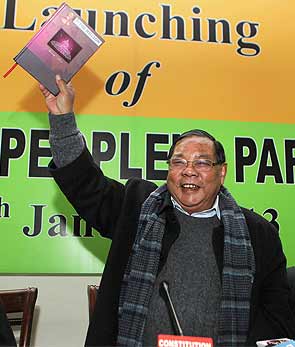
PA Sangma launches party, joins NDA


NEW DELHI : Pitching for the tribal cause, former Lok Sabha Speaker P A Sangma, who broke with Sharad Pawar's NCP last year to contest the Presidential elections against Congress nominee Pranab Mukherjee, launched his own National People's Party (NPP) on Saturday and joined hands with BJP-led NDA.

Launching the NPP at the "national level," here Sangma said, it has been active for long as a recognised party from Manipur. Sangma had previously joined hands with NDA after he put together a coalition of north-east parties ahead of the 2004 election.

The former Speaker, who is president of the party, said his daughter Agatha, MP from Tura, Meghalaya, will remain "in NCP for the time being on technical grounds," but sounded confident that "she will fight the next elections as an NPP candidate."

Agatha had to resign as Union minister on her party NCP's directions after she campaigned for her father PA Sangma in the July, 2012 Presidential elections in defiance of the party which is a constituent of the ruling UPA.

"Book will be the national symbol of the party because we believe that only literacy and education can empower the weaker sections," said Sangma.

NPP will contest the Meghalaya assembly elections due soon and is ready with the names of 33 candidates, Sangma announced.

Sangma was backed by the BJP-led NDA during the Presidential polls, and hence it was almost expected that he would join hands with the Opposition alliance.

Sangma who unsuccessfully contested the Presidential polls last year as a candidate of the Tribal Forum of India said here on Saturday that his party will give due importance to tribal and women issues.

"Though the party is meant for all and its membership is open for everyone, it is going to be tribal centric," said Sangma.

He announced that former Union minister Arvind Netam will be working president of the new party.

2 Boys allegedly raped 15-yr-old girl in Delhi

New Delhi, 7 Jan 2013 [IANS] --- A 15-year-old girl was allegedly raped by two people, including a juvenile, after they barged into her house when she was alone, police said Sunday. Both have been apprehended.

According to police, the girl, a class 9 student, is a resident of Mayur Vihar area. 

"On Friday, when the girl was alone in her house, the 17-year-old juvenile, who lives in the neighbourhood, and the other man barged into her house and both took turns to rape her," said a police officer.

Both the rapists then fled after warning her of dire consequences if she revealed the incident.

The victim however told her parents, who then approached police and got a case registered against both the accused.

"Both the accused have been taken into custody and further investigations are underway," said police.

A man raped 4 minor girls in West Bengal

Bankura, West Bengal, 7 Jan 2013 [NDTV] --- Four minor girls, aged between five and 10, have allegedly been raped by a 40-year-old man in West Bengal's Bankura district. The incident reportedly occurred on January 3. The accused, a grocery shop owner, was arrested last night. 

An FIR lodged at the Belatore police station by the guardians of the victims says that the four girls had gone to the grocery shop at around 3 pm on January 3 to buy cake. On the pretext of giving them cake, the grocer is alleged to have taken the girls to a nearby room and raped them.

The girls are said to have given an account of their torture to their parents, following which the complaint was lodged. Reports of the girls' medical examination are awaited. The accused is due to be produced in court soon.

Sunday, January 6, 2013

5 CRPF men raped women in Assam

Lakhimpur, 6 Jan 2013 [PTI] --- A CRPF jawan was arrested on  Januay 4 for allegedly raping a differently-abled woman in Assam's North Lakhimpur district.

Police said that five CRPF jawans had gone to the market in Chaulduwa area in Lakhimpur town and two of them allegedly raped the woman.

Police visited the spot and arrested one of the CRPF jawans. The woman was taken to a local hospital and the matter is being investigated, police said.

Featured Post

KHRC Condemns CM's Churachandpur Helicopter Visit

Lamka, July 4, 2026: The Kuki Human Rights Council (KHRC) has strongly condemned the Government of India for facilitating Manipur Chief Min...

Recent Posts